
UBC and Musqueam have a long standing and deepening relationship.
Campus and Community Planning (C&CP) and Musqueam representatives engage on campus land use planning initiatives, including Musqueam cultural presence projects, such as public artwork, Musqueam cultural resource management on campus; landscape and building designs; and campus plans. Through this work, listening, knowledge sharing, and mutual learning have deepened, contributing to more thoughtful and enduring outcomes.
Together, this work represents an important step in strengthening the relationship between UBC and Musqueam and in supporting a shared commitment to care for these lands for generations to come.
Musqueam involvement in planning the campus
UBC is engaging Musqueam representatives on landscape and building designs, campus and neighbourhood plans, and strategic initiatives (e.g. UBC’s Climate Action Plan), working together to:
- Better understand and incorporate Musqueam needs, interests, cultural knowledge and practices into planning the campus.
- Strengthen Musqueam presence and welcome by working together to make visible, honour and celebrate the longstanding relationship with the land.
- Manage potential impacts of growth on local services, ecology and culturally important areas, such as Pacific Spirit Regional Park.
Explore examples below.
Campus Meadows

A number of lawns on campus are being reimagined as thriving ecosystems, blending biodiversity with cultural significance. What was once a traditional grass lawn now blooms as a pollinator meadow. There are currently two pollinator meadows on campus, one along Main Mall and one along University Boulevard. Aligning landscapes more closely to the local ecology is key to achieving the long-term goals envisioned for UBC’s Vancouver campus – including increased biodiversity and strengthening Musqueam presence and welcome on campus.
The concept of planting meadows on campus was an outcome of engagement with Musqueam representatives through discussions about integrating Musqueam values and knowledge into planning and design of landscapes. The seed mixes chosen for these meadows include plants native to this area and culturally significant to Musqueam, as well as introducing plants from the Garry Oak ecosystem, native to southeastern Vancouver Island. Rising temperatures caused by climate change are narrowing the ecological differences between the two regions, making these ecosystems a fitting model for adaptation.
Deeper engagement with Musqueam and evolving knowledge of Indigenous practices and climate adaptive planting are enhancing the ecological, educational and social role landscapes play on the campus.
Learn more:
MacIsaac Health Building
Musqueam representatives helped shaped the design of the building and landscape, creating a vision for Musqueam culture and welcome at this gateway to campus. The building opened in 2026. Their involvement is reflected in building and landscape features, including:
- A building design with warm wood finishes, exposed timber, terracotta cladding and filtered daylight in the atrium
- A prominent landscape created by shifting the building footprint north, with Indigenous plantings, many culturally significant to Musqueam. Ten plants are identified on site signage in hən̓q̓əmin̓əm̓, English, along with their botanical names
- Musqueam Welcome at the building entrance, expressed through indoor and outdoor artworks by Musqueam artists
- Musqueam storytelling and cultural presence reflected through artworks displayed throughout the building and its entrance


Museum of Anthropology Landscape Renewal


The seismic upgrade and renewal of the Museum of Anthropology’s Great Hall created an opportunity to reimagine the museum’s exhibit landscape through a contemporary Indigenous lens. The 1977 design by Cornelia Oberlander, envisioned as an outdoor museum, was inspired by the landscapes and inlets of Haida Gwaii. As the museum resides on the traditional territory of the Musqueam (xʷməθkʷəy̓əm), this metaphor was considered an inaccurate representation of the cultural specificity of place.
Musqueam worked with the museum, Hapa Collaborative, Campus and Community Planning representatives to “correct the narrative” of the landscape, from a Haida landscape to a landscape that is an represents these lands. Musqueam's vision for the museum’s exhibit landscape was to transform from its original metaphor as a saltwater inlet to a metaphor of a river estuary.
The landscape design borrowed from the anthropological concept of “forest garden,” highlighting the shaping and cultivation of forests by humans over millennia, rather than assuming an untouched landscape. The design extends this concept into meadow and aquatic gardens, using a totally native plant palette culturally significant to Musqueam. The gardens are reframed as spaces for harvesting plants for use including for medicine and ceremonies, making space for Musqueam cultural work as well as providing opportunities for public education.
Learn more about the landscape design:
Musqueam artworks, naming and symbols
C+CP and Musqueam have worked together over the years on projects that bring Musqueam art, language, cultural symbols, and stories into the campus landscape.
MacIsaac Health Building Artworks
The MacIsaac Health Building features artworks by six Musqueam artists, installed both indoors and outdoors. Musqueam (xʷməθkʷəy̓əm) representatives were involved throughout the planning of the building and landscape, shaping a vision of Musqueam culture and welcome at this gateway to campus. These commissioned artworks are central to that vision.
Learn more about the vision for Musqueam culture and welcome that guided the planning and design of the building and landscape.
Explore each artwork below and learn more about the artist.
Aleen Sparrow
Enhancing building aesthetics through weaving patterns, 2026
Material: Printed Adhesive Vinyl
Fabricator: East Van Vinyl
Locations: Throughout the building on all floors


Artist Statement:
This six floor installation at the MacIsaac Health Building serves as a vertical loom, incorporating traditional weaving patterns with the elemental themes of Earth and Water. These designs represent a profound history of walking in one with nature, honouring a worldview where the land and its people are inseparable.
By showcasing our mathematical beauty and cultural depth of the Musqueam people, this work seeks to represent our community with dignity and grace. While these patterns are specific to this place, weaving itself is a universal language; nearly every culture shares a history of textile work.
As you move through these levels, may the rhythmic patterns offer a sense of grounding and connection and a visual reminder of our shared resilience and our enduring bond with the natural world.
Artist Biography:
Aleen Sparrow hails from the Musqueam Indian band, deeply rooted in her ancestral homeland. She is the daughter of the esteemed weaver, Debra Sparrow, who played a pivotal role in the revival of Salish weaving within the Musqueam community. For the past four years, Aleen has dedicated herself to the art of weaving, honing her skills and exploring the rich traditions of Salish design. Her journey has taken her from the loom to the realm of visual art, where she is now bringing her creative talents to life through mesmerizing murals and artwork adorning buildings. Born and raised in the heart of Musqueam, Aleen is steeped in her heritage and deeply connected to her people’s cultural traditions.
Beyond her creative pursuits, she wears many hats; from modeling with the Supernatural Modeling Agency, the first indigenous-owned and operated modeling agency in North America, to paddling with her local canoe club. However, perhaps her most cherished role is that of a mother. As she continues her artistic journey, Aleen is dedicated to a future where her work serves as a tribute to her people and her ancestors. With each creation, she endeavors to honor them in a good way.
Cole Sparrow-Crawford
Spinning Through Time, 2026
Materials: Reclaimed red cedar, anodized aluminum
Fabricator: Area 58 Innovation
Locations:
- The People of the River Grass: UBC Health, 4th Floor
- Creators Hands: Faculty of Arts, Arts Research Commons, 2nd Floor
- The Runner: School of Kinesiology, 2nd Floor
- Matriarch: Student Health and Wellbeing, 3rd Floor
- Seventh Generation: School of Nursing, 5th Floor
Image

|
Image

|
Image

|
Image

|
Image

|
Artist Statement
Taking into consideration the placement of these five pieces throughout the facility, each artwork directly reflects the school in whose room they are situated. With a contemporary metal and wood interpretation of the Salish spindle whorl, the design of each piece embodies the traditional elements used to tell stories in Coast Salish artwork, and reflects the values each school shares with these elements. The spindle whorls feature visual representations of traditional language, health, communal care and love in this place of study.
The spindle whorl has such a high cultural importance in creating the threads that are woven into our blankets and other garments, and these artworks show the modern threads of education that keep our communities and culture alive today.
Artist Biography
Being raised by strong, resilient, and proud people in the Musqueam village has shaped all aspects of my life as an Indigenous artist.
The knowledge passed down from generations before me, along with my experience and insight gained in my various studies have given me a unique perspective that has informed my work in the arts, business, and decolonial practice.
My motivation in a professional capacity and beyond is to create space for Indigenous people, culture, politics, and knowledge, while always contributing to my community.
Grace Ulu
Cultural Strands, 2026
Material: Aluminum, paint
Fabricator: Area 58 Innovation
Location: Main Floor Atrium

Artist Statement:
Cultural Strands by Grace Ulu is a work rooted in the interweaving of two Indigenous heritages — xʷməθkʷəyəm (Musqueam) and Fijian — reflecting the artist’s dual lineage and the living stories passed down through her family. The work draws on traditional Coast Salish art elements, honouring the memory of her late grandmother Arlene Point, while weaving together identity, land, and ancestry into a unified visual language. Cultural Strands speaks to the continuity of culture across generations, and the ongoing act of learning, remembering, and belonging.
Artist Biography:
Gracielene (Grace) Ulu is an Indigenous artist of Musqueam and Fijian descent, whose practice is rooted in family history, cultural storytelling, and the traditional art forms of her ancestors. Drawing from her mother’s xʷməθkʷəyəm (Musqueam) heritage and her father’s Fijian roots, Grace weaves these dual lineages into work that honors the memory of her late grandmother, Arlene Point, and the generations of knowledge they carry.
Kelly Cannell
Eye of the Fraser, 2026
Materials: Red cedar, aluminum, paint, printed adhesive vinyl
Fabricator: Area 58 Innovation
Location: Main entrance

Artist Statement
For countless millennia, the Musqueam people have thrived upon the land where the Fraser River water gracefully navigates the flats and rush towards the sea. Amid the shores of the Fraser River and the Salish Sea, Musqueam people, “People of the River Grass,” have forged a deep connection with their revered homeland. It is within this captivating setting that a remarkable tale unfolds—a tale encompassing the diverse array of creatures that find solace in the flowing currents of the Fraser River. These creatures hold immense importance, symbolizing the profound role they play within the rich tapestry of Musqueam Coast Salish culture. Glistening below the water’s surface, creatures emerge from the depths of the river. These are the eyes of the Fraser River.
Artist Biography
Kelly Cannell, a distinguished Coast Salish artist from the Musqueam Nation in Vancouver, B.C., is celebrated for her vibrant works that honour her cultural heritage and the natural world. Known for her intricate designs and bold use of colour, she seamlessly blends traditional Coast Salish art with contemporary techniques, creating pieces that bridge the past and present.
Her passion for glass art has led her to study at esteemed institutions such as the Pilchuck Glass School in Stanwood, Washington, and the Glass Furnace in Istanbul, Turkey. In 2019, she received a contemporary art scholarship that enabled her to collaborate with Venetian master glassblowers in Murano, Italy. She has further enriched her artistic practice through studies in silk-screen printing and acrylic painting at Emily Carr University of Art + Design.
Kelly’s work, admired for its powerful storytelling and innovative style, has earned her widespread recognition, including the 2024 Polygon BC Achievement Award in First Nations Art. Her public art installations can be found throughout Greater Vancouver and beyond, ranging from large-scale sculptures and integrated architectural pieces to intricate glass and metal works in community spaces, transit hubs, and educational institutions. Each installation serves as a visual narrative, deeply rooted in Coast Salish identity and responsive to the environment and community in which it resides.
Susan Point
New Horizons
Material: Acrylic, aluminum, paint
Fabricator: Area 58 Innovation
Location: Main Floor Shared Commons

Artist Statement
This original artwork is a creation of the unique legacy left to me by my ancestors. Although based on traditional motifs and elements of Salish Peoples, this contemporary artwork represents everyone who comes to the MacIsaac Health Building. This exciting artwork reminds us all of our thriving modern Coast Salish, Musqueam Culture, which connects to all cultural backgrounds of the people who now share and love this land. The richly painted and multi- layered acrylic is creating visual depth, reflection, shadows, and colour so this does not look like a flat surface, but rather a multi-level elaborate sculpture. The design incorporates perspective to create even further depth.
Artist Biography
Dr. Susan Point, O.C., RCA is a descendant of the Musqueam. Susan’s distinct style has inspired a crusade in Coast Salish art. She draws creativity from her ancestors’ stories and forged the use of non-traditional materials and techniques, therefore inspiring generations of artists. Susan is proud to be an Officer of the Order of Canada and has been presented with the Queen Elizabeth II Diamond Jubilee Medal for her continual contributions to Canada. In 2020, Susan was conferred Chevalier in the Ordre des Arts et des Lettres (Knight of Arts and Literature)—Order of France, French Ministry of Cultural Affairs.
Thomas Cannell
Honouring Ancestors
Material: Corten steel, anodized aluminum, led lighting
Fabricator: Area 58 Innovation
Location: Outside Main Entrance

Artist Statement
My artwork, Honouring Ancestors, is a story of the ancient trees that were once here. This artwork is a metaphor of time and attitudes towards ancient cedars.
My artworks are based on a visual language that is inspired by hundreds of generations of ancestors that once inhabited the whole area of the lower mainland. I often walk through Pacific Spirit Park imagining the way the trees stood 200 years ago. A thriving forest of old growth trees; because of the low elevation and coastal location, this forest was one of the most productive in the world, first ecologically, and then economically.
Long-lived species such as Douglas Fir, Spruce and Western Red Cedar grew to gigantic size in this environment; it was a new European rapacious appetite that began clearing this old forest. Where previously these trees were only lightly burned and hand cut by my ancestors, newcomers brought horse logging, then industrial scale clear cutting to this forest. Where once we would see the careful and thoughtful interventions of my ancestors, now not even the stumps of the giants are visible - they have all been removed. However, proof that they existed is still found in off-the-path gorges and Maple Grove Park.
I want this artwork to highlight the history of the area as a gathering place and transportation route as well as a place with beautiful old-growth forests; a Musqueam sacred place.
Artist Biography
The work of Coast Salish carver and designer Thomas Cannell reflects his respect and love for his Salish roots and the natural evolution of his people. Thomas works and lives on the Musqueam Reserve and has studied under and been mentored by his mother, Susan Point. He currently works on large-scale public art works in many different mediums with Susan and on his own. Thomas’ public art pieces are shown in Richmond, Vancouver, Burnaby and New Westminster.
Crests of Change Crosswalk
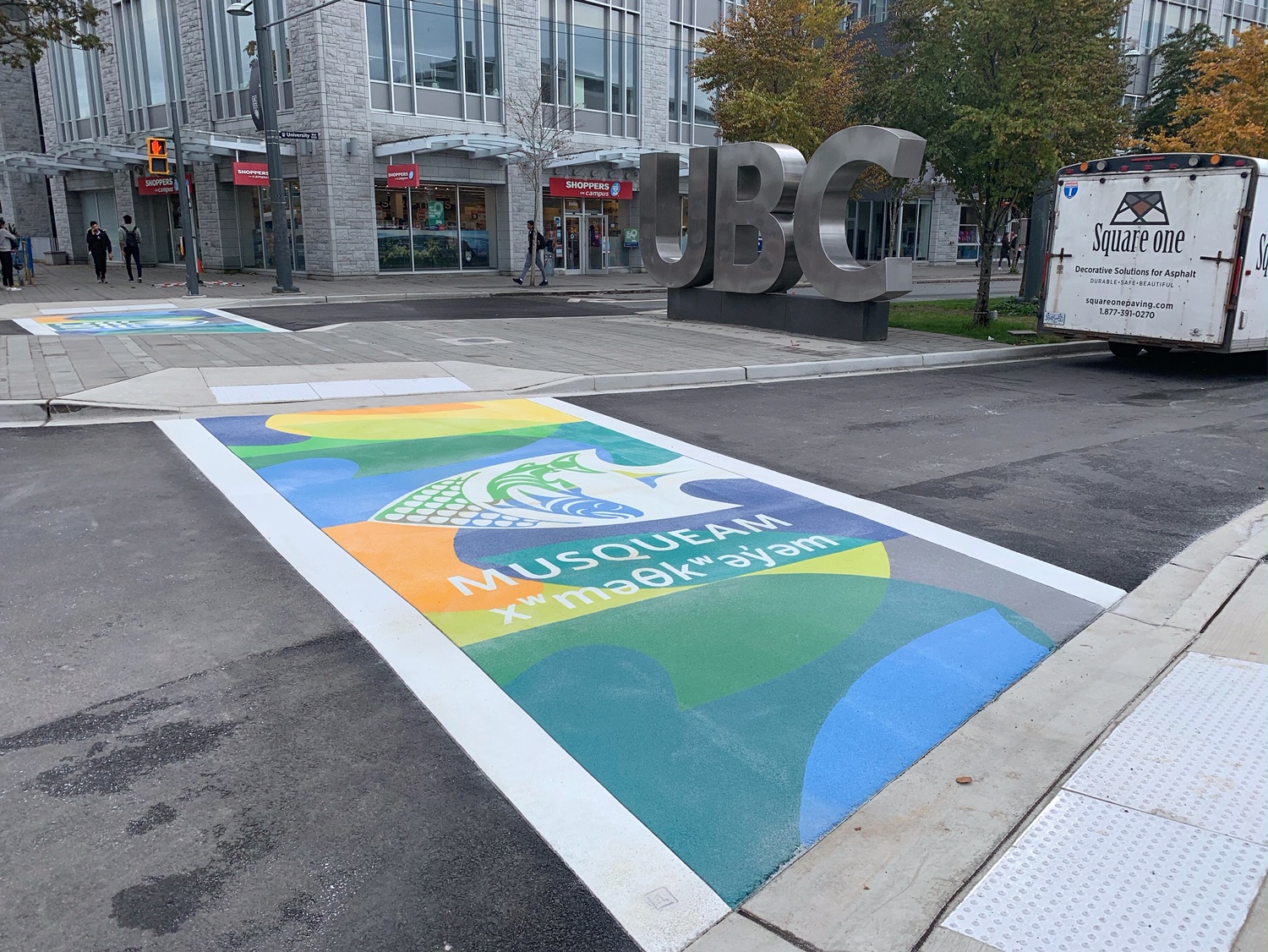
Designed by: Banter Grace & lollipop
Location: Intersection of University Boulevard and Wesbrook Mall.
Installation Date: 2020
A feature crosswalk was designed for UBC in collaboration with Musqueam to enhance the arrival experience to campus. The design uses the UBC and Musqueam crests woven together, acknowledging that UBC is situated on the ancestral, traditional and unceded lands of the Musqueam people.
ʔəlqsən, Brent Sparrow

Artist: Brent Sparrow
Location: Walkway between the UBC Bus Exchange and MacInnes Field
Installation Date: 2020
Material: Cast Bronze
ʔəlqsən is the hən̓q̓əmin̓əm̓ word for ‘point of land’. It is known to Musqueam ancestors as the Battleground of the West Wind, a natural landmark dividing the Fraser River estuary from Burrard Inlet. Sparrow created two different wood carvings featuring images of eagles, thunderbirds and salmon which were then cast in bronze. Together they are uplifting and inspiring—symbols of protection and enlightenment. The images suggest that learners come to the university where they grow into messengers, seekers and travellers.
Installed in 2020, there are 10 cast bronze pieces that are part of a weather protected walkway separating the UBC Bus Exchange. The installation enhances the arrival experience to UBC, brings cohesion and vibrancy to this highly public space, and informs those arriving to campus that UBC is on the traditional, unceded and ancestral territory of the Musqueam people.
Artist Biography

(left) Brent Sparrow. Photo by Martin Dee
A member of the Musqueam Indian Band, Sparrow trained as a welder but apprenticed alongside his mother, master carver Susan A. Point, and the late master carver John Livingston. His mother instilled in him an awareness and knowledge of his Musqueam culture, creating an inspiration and learning experience they share.
Musqueam Street Signs

The Musqueam street signs were created in 2018 through a partnership with the Musqueam First Nation to give a bilingual experience while travelling on campus and acknowledge the linguistic heritage of the UBC’s Vancouver campus. The names do not refer to traditional sites but instead to UBC’s geography. For example, the word “middle” used for Main Mall reflects its central position on campus.
Musqueam’s language, hən̓q̓əmin̓əm̓, uses a place based directional system which refers to the land and flow of water (e.g. upriver or downriver, inland and towards the shore) and not cardinal directions such as north, south, east, and west.
The names chosen by Musqueam seek to educate us about the way they perceive place, movement across the land, and to show everyone how their language and culture is intrinsically connected to their territory.
Musqueam Street Signs Map
We encourage you to walk around the UBC Vancouver campus to view the Musqueam street signs. As you stand near a sign, take note of where you are, and how the hən̓q̓əmin̓əm̓ names relate to your position on the land, in relation to the mountains and the Salish Sea.

Click on image to enlarge
Acknowledgements
Campus and Community Planning is grateful for Musqueam’s support in the street signs project and for the guidance of the Musqueam Community, Chief and Council, Elder Larry Grant, Leona Sparrow, Jill Campbell, Vanessa Campbell, and Jason Woolman.
Thank you to the Office of the President, First Nations House of Learning, UBC Building Operations, UBC Brand and Marketing, and UBC Media Relations. Also thanks to Ross Mills of Tiro Typeworks.